
The short answer
A business Instagram account run from Germany needs an Impressum under § 5 of the Digital Services Act (DDG), reachable from the profile, usually through a bio link labeled Impressum. Posts made for payment or other consideration from another company must be marked Werbung or Anzeige at the start, under the UWG and the Media State Treaty.
Key facts
- Since 14 May 2024 the Impressum duty sits in § 5 DDG, which replaced § 5 TMG with the same list of required details.
- Failing to keep the Impressum available can be fined up to €50,000 under § 33 DDG.
- The Federal Court of Justice accepted an Impressum reached through two links labeled Kontakt and Impressum (I ZR 228/03, 2006).
- § 5a(4) UWG presumes that a post promoting another company was paid for, unless the poster credibly shows otherwise.
- The state media authorities' guide says #ad, sponsored by and PR sample are not enough on their own; use Werbung or Anzeige.
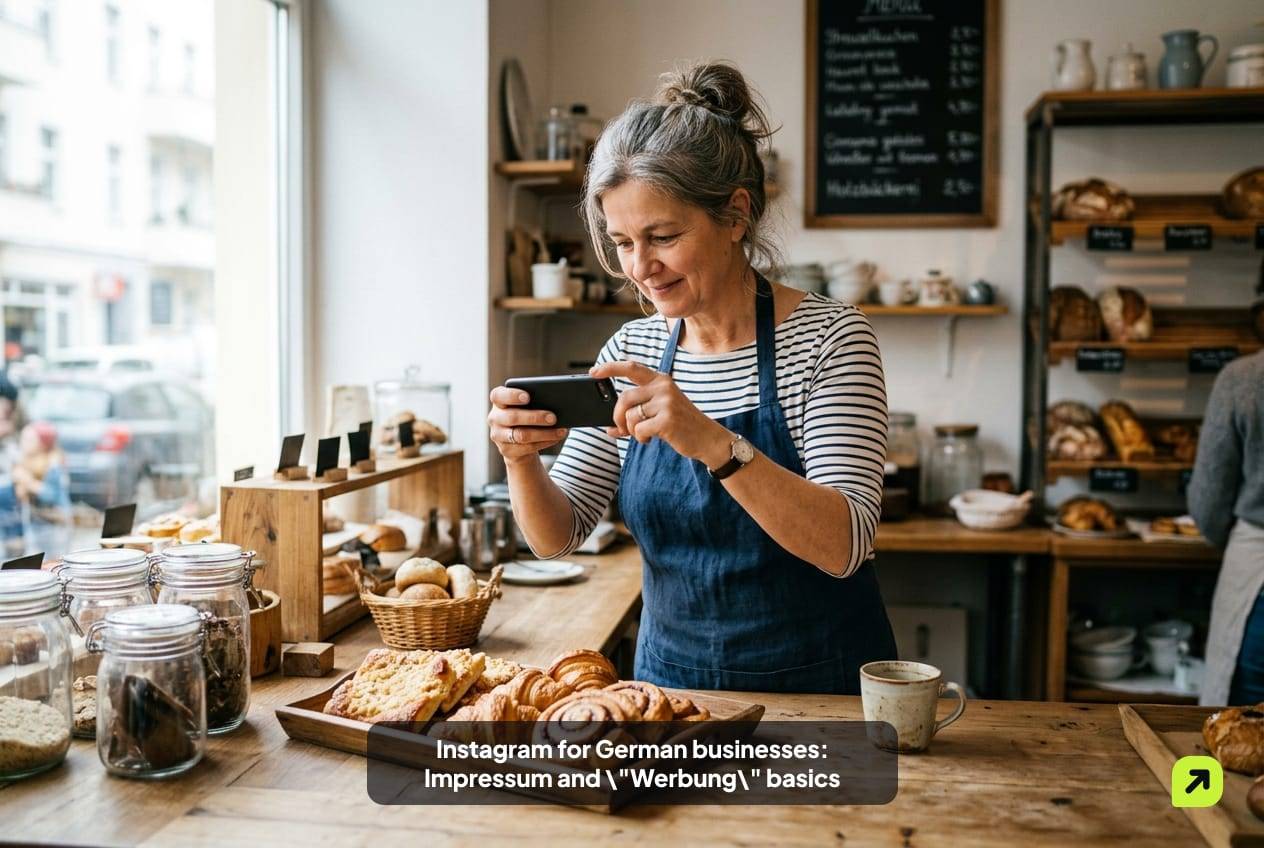
German rules for business accounts on Instagram come down to two questions. Can a visitor find out who runs the profile? And can they tell when a post is advertising? Both have clear legal answers, and both are cheap to get right.
This guide covers the Impressum duty, the labeling rules for paid posts, and where follower or like orders sit next to those rules. Laws and regulator guidance below were Checked October 2026. This is general information, not legal advice: for your own case, ask a lawyer or your chamber of commerce (IHK).
If you are a business in Germany thinking about buying Instagram followers and likes in Germany, read the labeling section first. Bought engagement does not change any of these duties, and it should never be used to make customers believe a business is more popular than it is.
Does a business Instagram account in Germany need an Impressum?
In most cases, yes. The duty used to sit in § 5 of the Telemedia Act (TMG). Since 14 May 2024 it sits in § 5 of the Digitale-Dienste-Gesetz (DDG), the German law that implements the EU Digital Services Act. The IHK in Bayreuth notes that the only change in wording was “Telemediendienst” becoming “digitaler Dienst”; the requirements themselves stayed the same.
The DDG applies to digital services offered on a business basis, normally for payment. An Instagram profile that sells, takes bookings or promotes a company is such a service in the eyes of most German lawyers and chambers of commerce. A café’s profile, a salon’s booking account and a freelance photographer’s portfolio all count.
The practical tell: if the account exists to win customers, plan for an Impressum. Purely private accounts are outside the rule, but “private” rarely describes a profile with a shop link in the bio.
If your imprint still says “Angaben gemäß § 5 TMG”, update it. The TMG is repealed, and citing a repealed law looks careless to anyone checking.
What has to be in the Impressum?
§ 5 DDG lists the details. Which ones apply depends on your legal form and trade.
| Required detail (§ 5 DDG) | Who needs it |
|---|---|
| Name and postal business address; for companies also legal form and authorized representatives | Everyone |
| Fast electronic contact, including an email address | Everyone |
| Commercial or similar register and registration number | Registered businesses (for example GmbH, UG, e.K.) |
| VAT ID or economic identification number | Businesses that hold one |
| Supervisory authority | Activities that need an official license |
| Chamber, professional title, the country that granted it, professional rules | Regulated professions such as lawyers, tax advisers, architects |
| Notice of winding up or liquidation | Companies in liquidation |
The address must be a real postal address where you can receive legal documents, not just a PO box. If you share a coworking address, check with the provider that mail and service of documents reach you there.
How do you link an Impressum from an Instagram profile?
Instagram has no dedicated imprint field. The usual answer is a link in the bio.
The legal test in § 5 DDG is that the details are easy to recognize, directly reachable and permanently available. In 2006 the Federal Court of Justice decided that an imprint reached through two links, labeled “Kontakt” and “Impressum”, can meet that test (BGH, I ZR 228/03). German chambers and law firms apply that two-click idea to social profiles today.
A setup that follows that rule:
- Add your website’s imprint page as one of the links on your profile, labeled Impressum.
- If you use a link page, put a visible “Impressum” entry on it that opens the imprint directly.
- Avoid vague labels like “Info” or “About”. Courts and practitioners treat “Impressum” and “Kontakt” as the terms users understand.
- Keep the privacy policy (Datenschutzerklärung) one tap away as well. It is a separate duty under data protection law.
Check the link after every profile edit. A broken bio link means the imprint is no longer “permanently available”.
What happens if the Impressum is missing?
Two things can happen. The authority can fine you: § 33 DDG allows a fine of up to €50,000 for failing to keep the § 5 information available, correct and complete. In practice, the more common risk is a formal warning letter (Abmahnung) from a competitor or a competition association, usually with a cease-and-desist declaration and a lawyer’s bill attached.
Neither depends on the size of the account. A missing imprint is easy to spot, which is exactly why it gets flagged.
When does a post need the word Werbung?
Three sets of rules overlap here.
Unfair competition law. § 5a(4) UWG says it is unfair to hide the commercial purpose of a post when that purpose is not obvious from the context. Since May 2022 the same paragraph adds a rule written for influencers: a post that promotes another company is not commercial if you received no payment or similar consideration from it. But the law presumes you did, unless you can credibly show otherwise. The UWG’s blacklist, item 11, separately bans paid editorial-style promotion that readers cannot recognize as advertising.
Media law. § 22 of the Media State Treaty (MStV) requires advertising in online media to be clearly recognizable and separated from the rest. The state media authorities (Landesmedienanstalten) supervise this.
Court practice. In September 2021 the Federal Court of Justice decided three Instagram cases (I ZR 90/20, I ZR 125/20 and I ZR 126/20). A post paid for by a jam maker, tagged to the brand and unlabeled, was unlawful. Two unpaid posts with brand tags were allowed. The court also said that even without payment, a post can count as advertising when it praises a product with no critical distance at all.
For a business, the result is simple. If another company pays you, sends free goods tied to a post, covers a trip or gives you anything else in return, label the post.
How should the label look?
The most detailed public guidance comes from the joint guide of the state media authorities, Werbekennzeichnung bei Online-Medien (current edition dated May 2025). Its main points for Instagram:
- Use “Werbung” or “Anzeige”. The prefix “bezahlte Werbepartnerschaft” also works, so Instagram’s paid partnership tool is fine when it shows that wording.
- Put the label at the start, visible without scrolling or tapping “more”, on phone and desktop. In a caption, make it the first word.
- Label each Story slide that carries the promotion, not just the first.
- An image-only post needs the label in the image itself.
- “#ad”, “sponsored by”, “PR sample”, “Advertorial” and similar terms are not enough on their own.
- Don’t label everything “just in case”. The guide warns that unnecessary labels weaken the ones that matter.
| Situation | What the guide recommends |
|---|---|
| Paid post or post in return for goods, a trip or an event invite | “Werbung” or “Anzeige” at the start |
| Discount code from a partner brand | “Werbung” or “Anzeige” right next to the code |
| Affiliate link | An asterisk (*) at the link, with an explanation nearby |
| Free product shown only in passing, worth more than €100 | “enthält Produktplatzierung” or “Unterstützt durch [product]” at the start |
| Tagging friends, locations or sources with no deal behind it | No label needed |
| Your own products on a clearly commercial shop or brand account | No label needed |
Do posts about your own products need a label?
Not on a company account that is plainly commercial. The media authorities’ guide says channels that are obviously commercial, such as known brands and online shops, need no advertising label for their own goods.
The picture changes on a personal account. A stylist who posts mostly lifestyle photos and then promotes her own product line should mark those posts, because a visitor cannot tell the profile is a sales channel. The same applies when you share another account’s post about your own products.
For the other countries we cover, see our overview of influencer disclosure rules by country and more guides in the local marketing section.
Where do bought followers and likes fit?
The Impressum and labeling rules above say nothing about follower or like orders, but the UWG does reach them when they are used to sell. Item 23c of the same UWG blacklist bans submitting or commissioning fake consumer reviews or endorsements, and misrepresenting them on social media, to promote sales. It comes from EU rules whose recital names likes on social media as an example of an endorsement. Checked October 2026.
Use orders for what they are good at: giving a new account or a new product post a fair first look, so the first visitors don’t land on an empty profile. Do not use follower numbers to tell customers you are the most popular bakery in town, and do not show inflated numbers to a brand you want to work with as proof of influence. A brand can ask for reach and audience data from your Instagram insights, and those numbers tell a different story from the follower count.
If you do place an order, the practical checks are the same in Germany as anywhere. Our guide on whether buying Instagram followers is safe covers the account side. Our link check explainer shows how we confirm the public profile before you pay, so an order cannot land on the wrong account.
A short checklist for German business profiles
| Check | Done when |
|---|---|
| Impressum link | A link labeled Impressum in the bio opens the imprint within two taps |
| Impressum details | Every § 5 DDG item that applies to your legal form is there, with a real postal address |
| Old law references | No “§ 5 TMG” left on the imprint page |
| Paid or gifted posts | “Werbung” or “Anzeige” is the first word, or the paid partnership tool is on |
| Stories | Every promotional slide carries the label |
| Affiliate links and codes | Marked next to the link or code |
| Follower or like orders | Used for first impressions of new posts, never as a popularity claim to customers or brands |
If one of these needs a judgment call, such as whether a free product counts as consideration, ask your IHK or a lawyer before the post goes live, and keep a note of the answer.
Sources
Sources (10)
- Digitale-Dienste-Gesetz (DDG) § 5 Allgemeine Informationspflichten
- Digitale-Dienste-Gesetz (DDG) § 33 Bußgeldvorschriften
- Gesetz gegen den unlauteren Wettbewerb (UWG) § 5a
- UWG Anhang (zu § 3 Absatz 3), Nr. 11 and Nr. 23c
- Medienstaatsvertrag (MStV) § 22 Werbung, Sponsoring, Gewinnspiele
- Die Medienanstalten: Leitfaden Werbekennzeichnung bei Online-Medien (Stand Mai 2025)
- BGH, Urteil vom 20. Juli 2006, I ZR 228/03 (Anbieterkennzeichnung im Internet)
- IHK für Oberfranken Bayreuth: Telemediengesetz (TMG) ist jetzt Digitale Dienste Gesetz (DDG)
- Händlerbund: Impressum für Influencer
- Noerr: BGH-Grundsatzurteile zum Influencer-Marketing
Frequently asked questions
Does a small shop's Instagram account need an Impressum?
Is it enough to write Impressum on our website in the bio?
Do posts about our own products need the Werbung label?
Can we use #ad instead of Werbung on German posts?
 Eleanor WhitmoreContent Lead, Instagram and TikTokEleanor Whitmore writes Socipro's Instagram, TikTok and local guides. The platform guides cover how Reels, Explore and the For You feed choose what to show and how a LIVE gets its first viewers. The local guides cover posting times by time zone and the ad-disclosure rules in each country Socipro serves.
Socipro sells the services mentioned in this article. How we write and check our guides: editorial policy.